
This Cummins 2638 fault code document is a 10-page troubleshooting PDF for aftertreatment diesel oxidation catalyst conversion efficiency faults. It explains why Fault Code 2638 sets, what the ECM does when it is active, and which inspection and service checks are used before clearing the fault.
Official Cummins 2638 fault code document details
| Brand | Cummins |
|---|---|
| Model coverage | ISX11.9 CM2250, ISX15 CM2250, GX CM2250, QSL9 CM2250, QSB6.7 CM2250 |
| System/Group | ISB6.7 CM2250 (2010-12) / DTCs; Aftertreatment System |
| Publication no. | Associated bulletin numbers shown: 4022250, 2883445, 4022256, 4022255 |
| Year/Revision | Last Modified: 15-Sep-2010; 29-Dec-2010 |
| Pages | 10 |
| File size | 0.2 MB |
| Format | |
| Language | English |
Document table of contents
- Overview
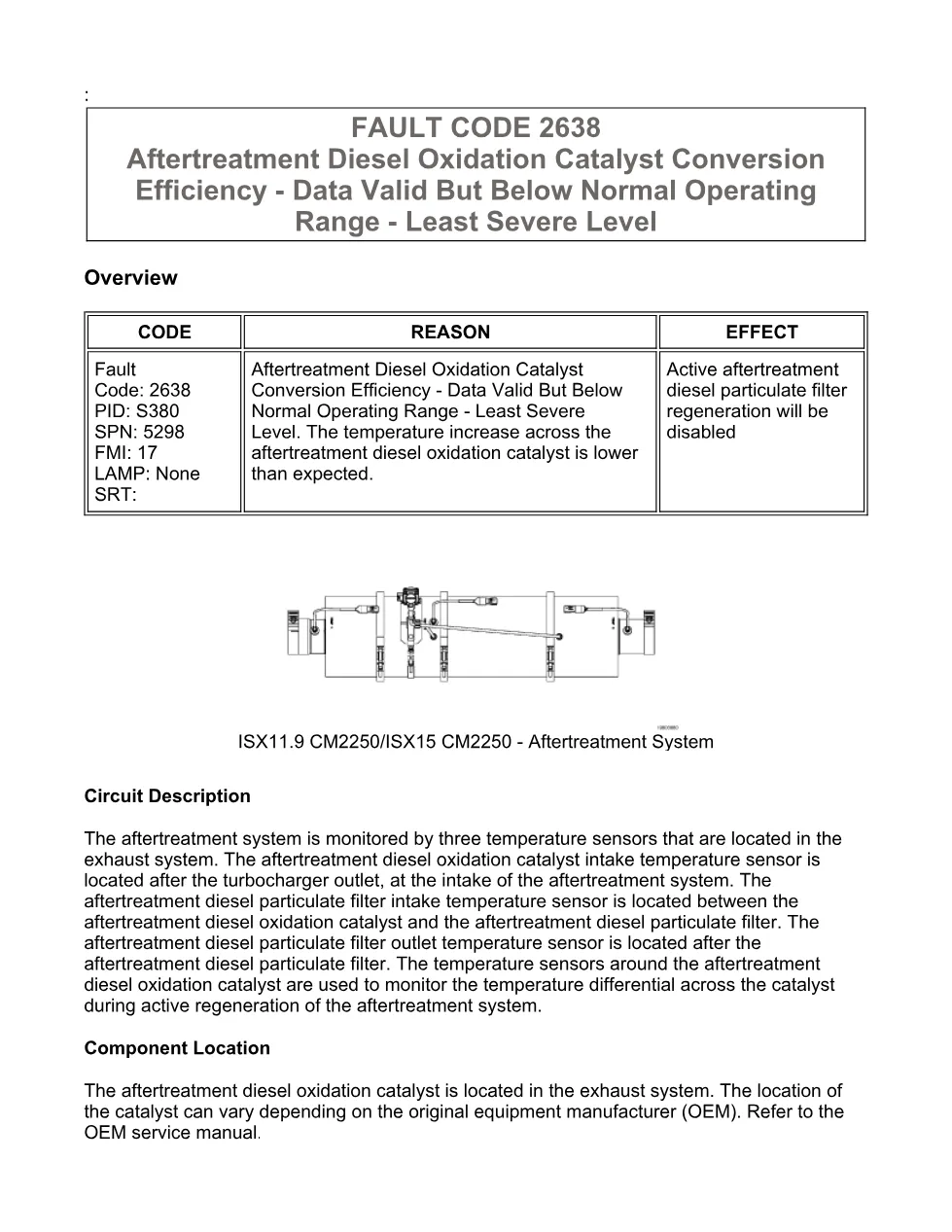
- Circuit Description
- Component Location
- FAULT CODE 2638 – Aftertreatment Diesel Oxidation Catalyst Conversion Efficiency – Data Valid But Below Normal Operating Range – Least Severe Level
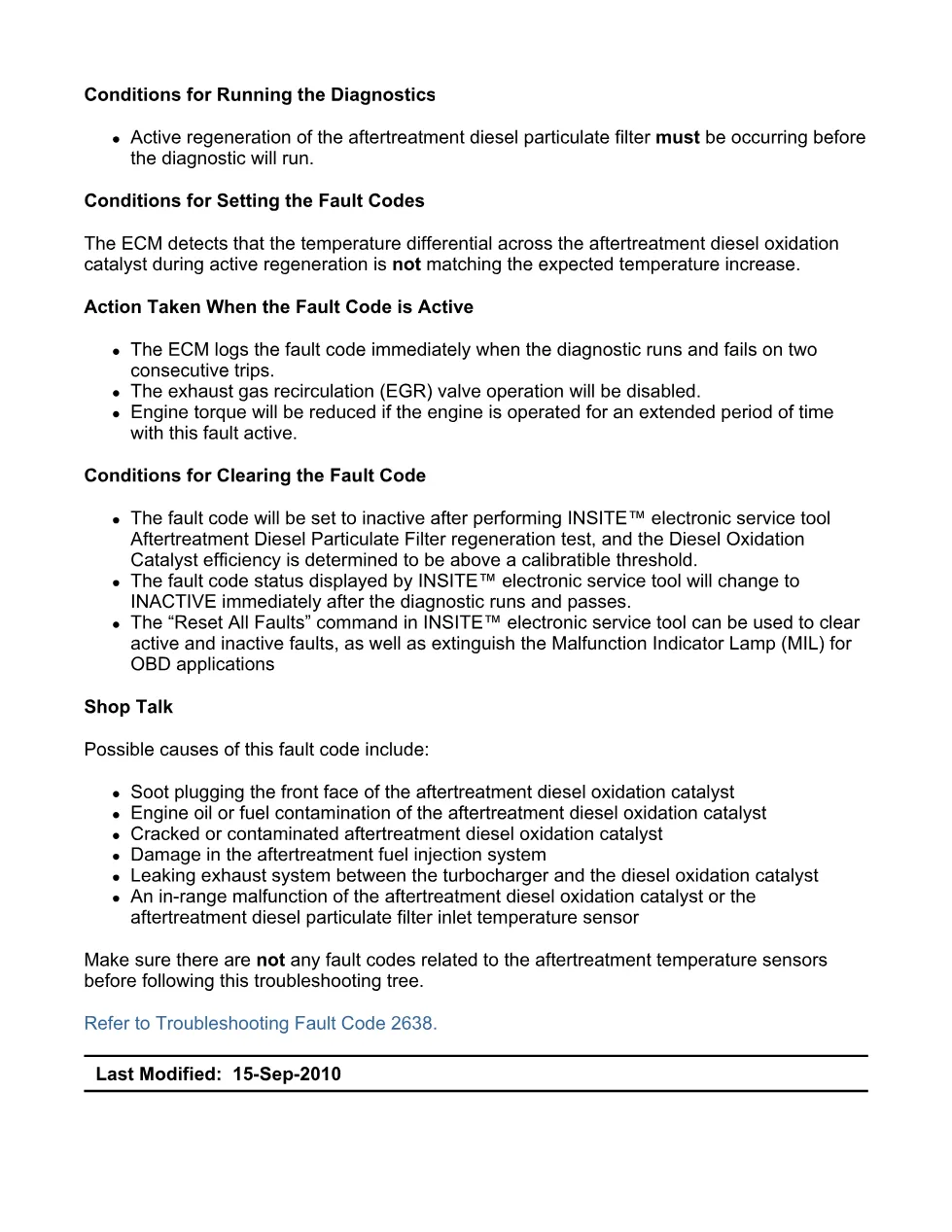
- Conditions for Running the Diagnostics
- Conditions for Setting the Fault Codes
- Action Taken When the Fault Code is Active
- Conditions for Clearing the Fault Code
- Shop Talk
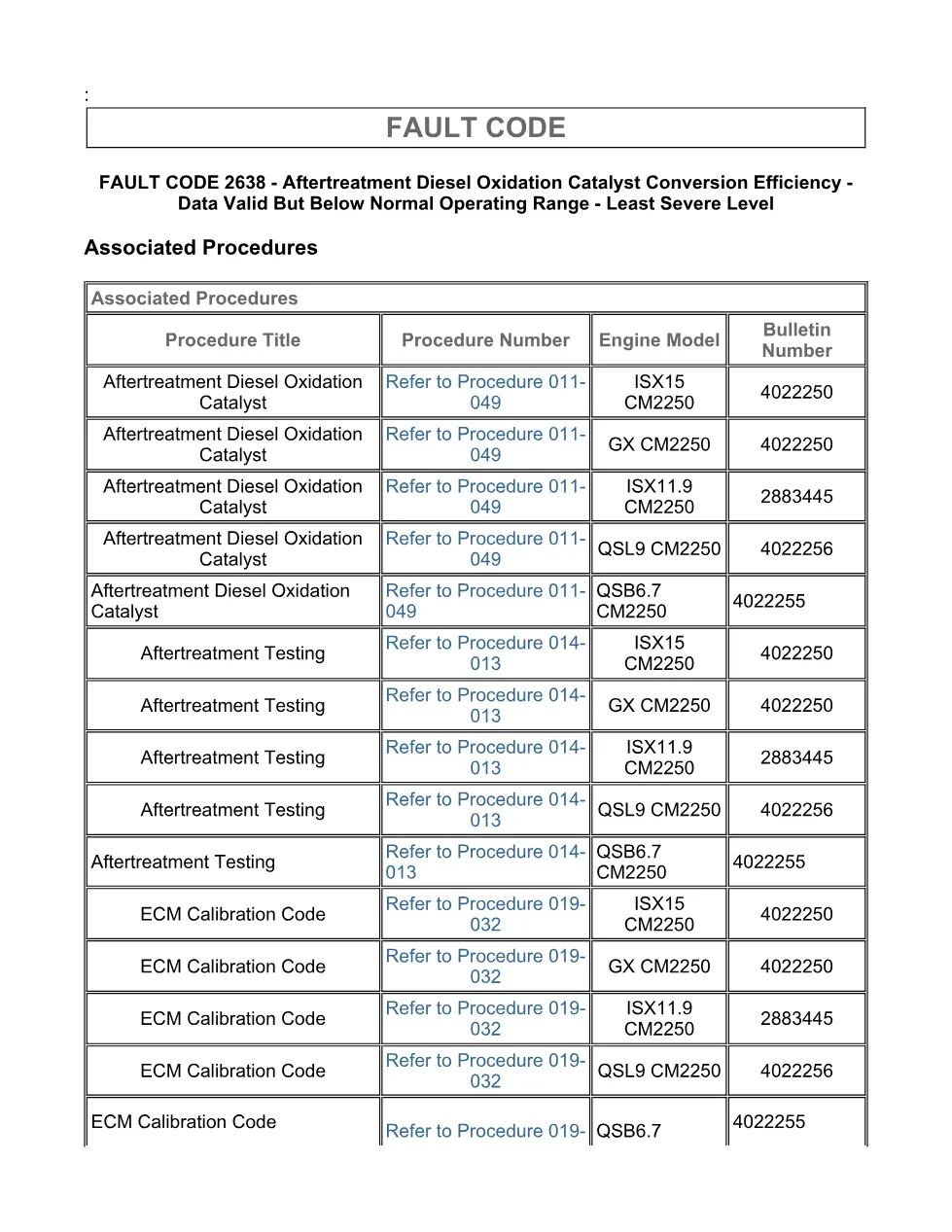
- Associated Procedures
- Troubleshooting Steps
- Guided Step 1 – Check the fault codes.
- Guided Step 2 – Inspect the aftertreatment diesel oxidation catalyst.
- Guided Step 3 – Check the turbocharger outlet.
- Guided Step 4 – Perform a stationary regeneration.
- Guided Step 5 – Check ECM calibration and clear fault codes.
Applicable truck models
The extract identifies CM2250 engine applications and aftertreatment procedures for ISX15 CM2250, GX CM2250, ISX11.9 CM2250, QSL9 CM2250, and QSB6.7 CM2250. The component location can vary by original equipment manufacturer, so the document directs technicians to the OEM service manual for catalyst location and exhaust plumbing access. See the manufacturer source at Cummins official website.
Who needs this Cummins 2638 fault code manual
This manual is for diesel technicians diagnosing low diesel oxidation catalyst conversion efficiency during active regeneration. It is also useful for workshop owners checking whether the next job step is exhaust leak repair, DOC inspection, turbocharger outlet contamination checks, stationary regeneration, or ECM calibration review.
The procedure states that active regeneration of the aftertreatment diesel particulate filter must be occurring before the diagnostic will run. The ECM sets the fault when the temperature differential across the aftertreatment diesel oxidation catalyst does not match the expected increase, and active diesel particulate filter regeneration will be disabled. Listed possible causes include soot plugging, engine oil or fuel contamination, cracked or contaminated catalyst cells, damage in the aftertreatment fuel injection system, exhaust leaks between the turbocharger and diesel oxidation catalyst, and in-range temperature sensor malfunctions. The workflow uses INSITE™ electronic service tool checks, Procedure 011-049 for the aftertreatment diesel oxidation catalyst, Procedure 014-013 for aftertreatment testing, and Procedure 019-032 for ECM Calibration Code updates.
Full PDF available in the DiagTechPro manuals library, free account required to download.
Related manuals library
Sản phẩm liên quan cho hãng này
Cùng brand theo taxonomy hiện có trong catalog WooCommerce.

Cummins Calterm Version 5.16 – Advanced ECM Control and Precision Tuning for Cummins Engines

Cummins INSITE 9.3 – The Essential Diagnostic Tool for Cummins Engines

Cummins InCal CE – The Calibration and Configuration Tool for Cummins Engines


