
This Cummins 415 fault code document is a 2-page troubleshooting sheet for oil pressure engine protection on ISB CM550 applications. It identifies PID P100, SPN 100, FMI 1, explains how the ECM monitors the oil pressure sensor signal, and gives checks using a mechanical gauge and diagnostic tool. The file is intended for service use when Fault Code 415 is active or stored.
Official Cummins 415 fault code document details
| Brand | Cummins |
|---|---|
| Model coverage | ISB CM550 (1990-94) |
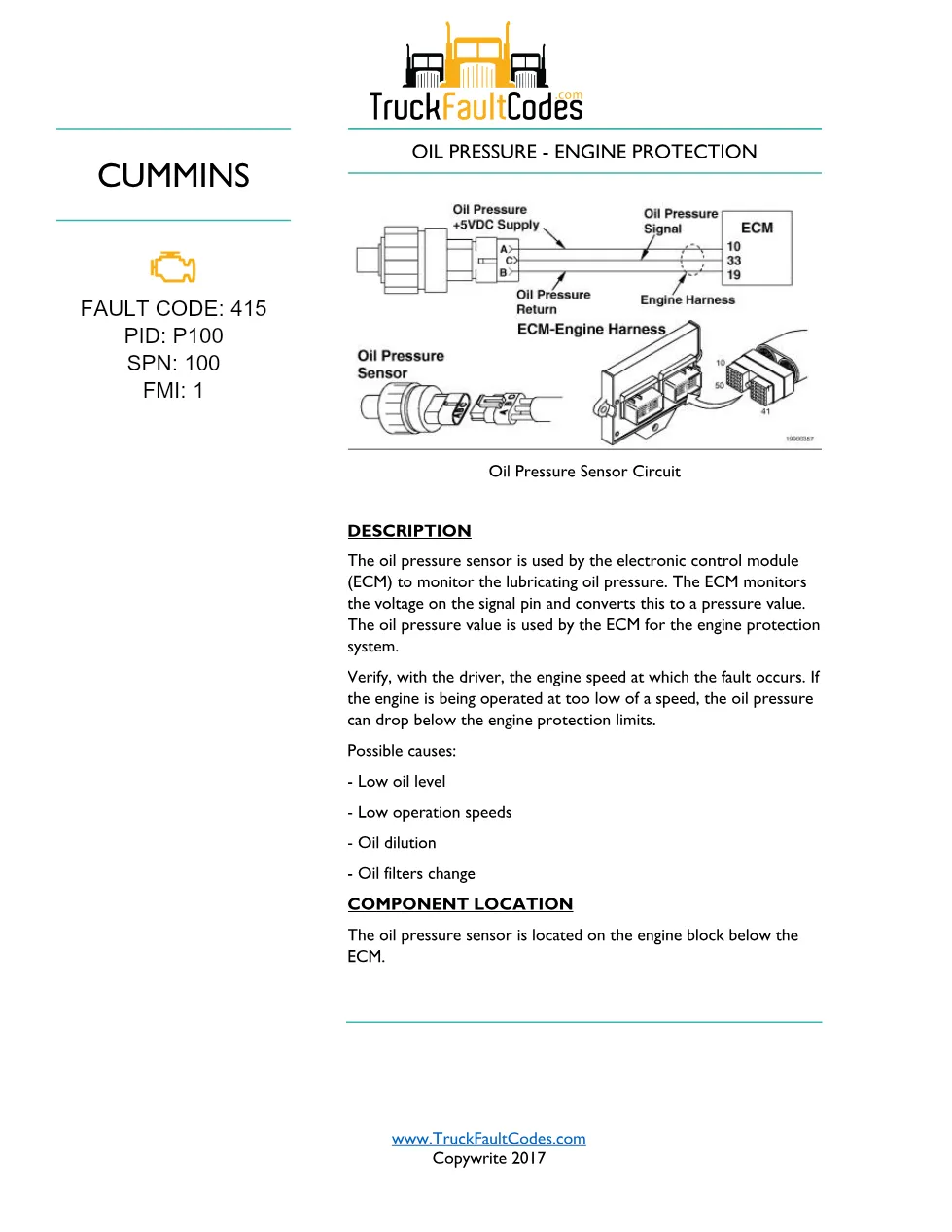
| System/Group | DTCs; Oil Pressure – Engine Protection; Oil Pressure Sensor Circuit |
| Publication no. | Not shown in extract |
| Year/Revision | Unknown; source page shows Copywrite 2017 |
| Pages | 2 |
| File size | 0.1 MB |
| Format | |
| Language | English |
Document table of contents
- FAULT CODE: 415
- PID: P100
- SPN: 100
- FMI: 1
- OIL PRESSURE – ENGINE PROTECTION
- Oil Pressure Sensor Circuit
- DESCRIPTION
- Possible causes
- COMPONENT LOCATION
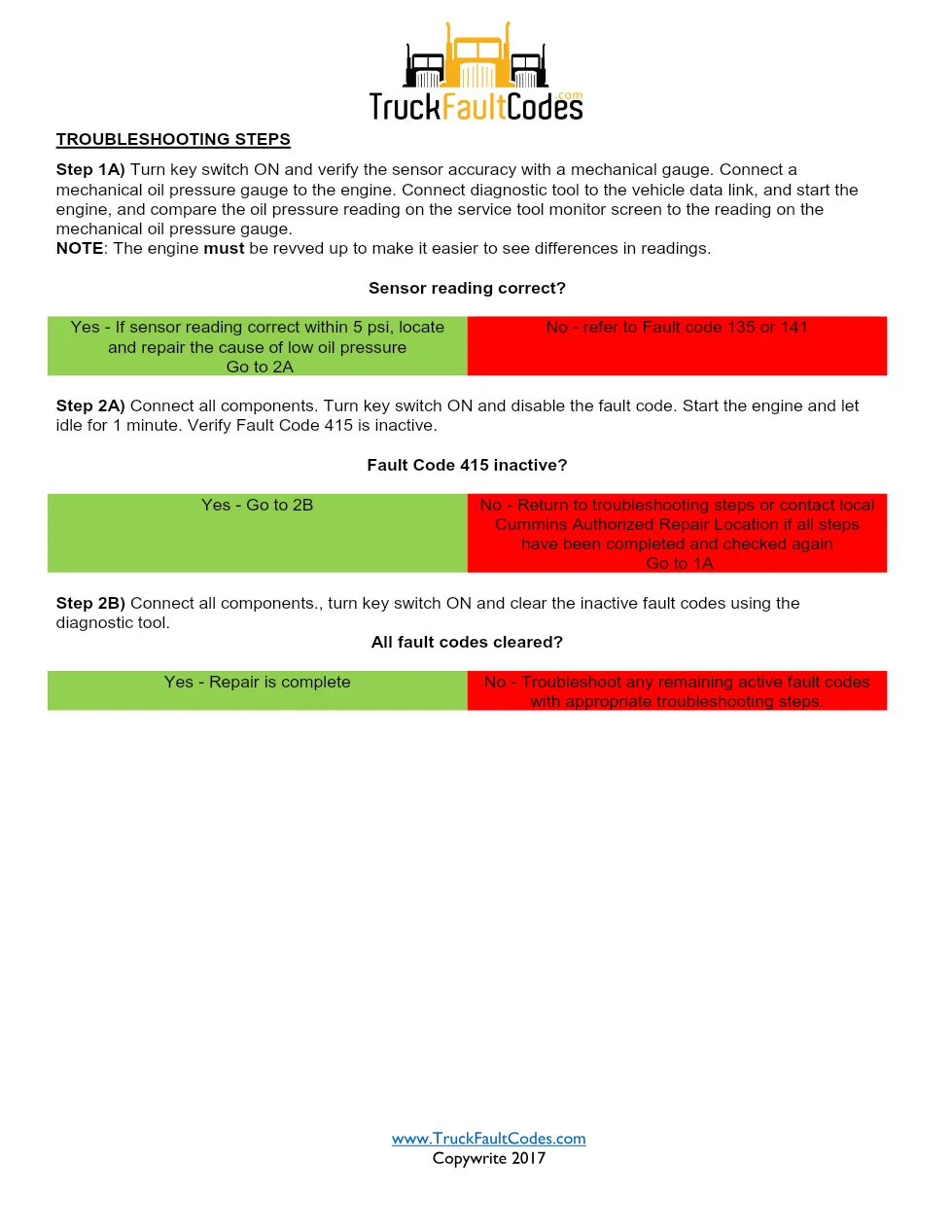
- TROUBLESHOOTING STEPS
- Step 1A) Turn key switch ON and verify the sensor accuracy with a mechanical gauge.
- Step 2A) Connect all components. Turn key switch ON and disable the fault code.
- Step 2B) Connect all components., turn key switch ON and clear the inactive fault codes using the diagnostic tool.
Applicable truck models
This document applies to Cummins ISB CM550 engines listed under ISB CM550 (1990-94) DTCs. The extract does not name specific truck makes or chassis models, so coverage should be matched by engine control system and fault code information: Fault Code 415, PID P100, SPN 100, and FMI 1. The oil pressure sensor is described as being located on the engine block below the ECM, and the procedure focuses on comparing service tool oil pressure data with a mechanical oil pressure gauge. For manufacturer information, visit the Cummins official website.
Who needs this Cummins 415 fault code manual
Workshop technicians, fleet mechanics, and diagnostic tool users need this Cummins 415 fault code manual when investigating low oil pressure protection faults, sensor accuracy, or engine protection shutdown complaints. It is useful when the driver reports the fault at low engine speed, because the document notes that operating the engine too slowly can allow oil pressure to drop below engine protection limits.
The troubleshooting content lists possible causes including low oil level, low operation speeds, oil dilution, and oil filters change. Step 1A instructs the technician to connect a mechanical oil pressure gauge, connect a diagnostic tool to the vehicle data link, start the engine, and compare the service tool monitor reading against the gauge. The note says the engine must be revved up to make differences in readings easier to see. If the sensor reading is correct within 5 psi, the technician is directed to locate and repair the cause of low oil pressure. If the reading is not correct, the document points to Fault code 135 or 141.
After repair, Step 2A covers reconnecting all components, turning the key switch ON, disabling the fault code, starting the engine, idling for 1 minute, and verifying that Fault Code 415 is inactive. Step 2B covers clearing inactive fault codes with the diagnostic tool and troubleshooting any remaining active fault codes with the appropriate steps.
Full PDF available in the DiagTechPro manuals library, free account required to download.
Related manuals library
Sản phẩm liên quan cho hãng này
Cùng brand theo taxonomy hiện có trong catalog WooCommerce.

Cummins Calterm Version 5.16 – Advanced ECM Control and Precision Tuning for Cummins Engines

Cummins INSITE 9.3 – The Essential Diagnostic Tool for Cummins Engines

Cummins InCal CE – The Calibration and Configuration Tool for Cummins Engines


