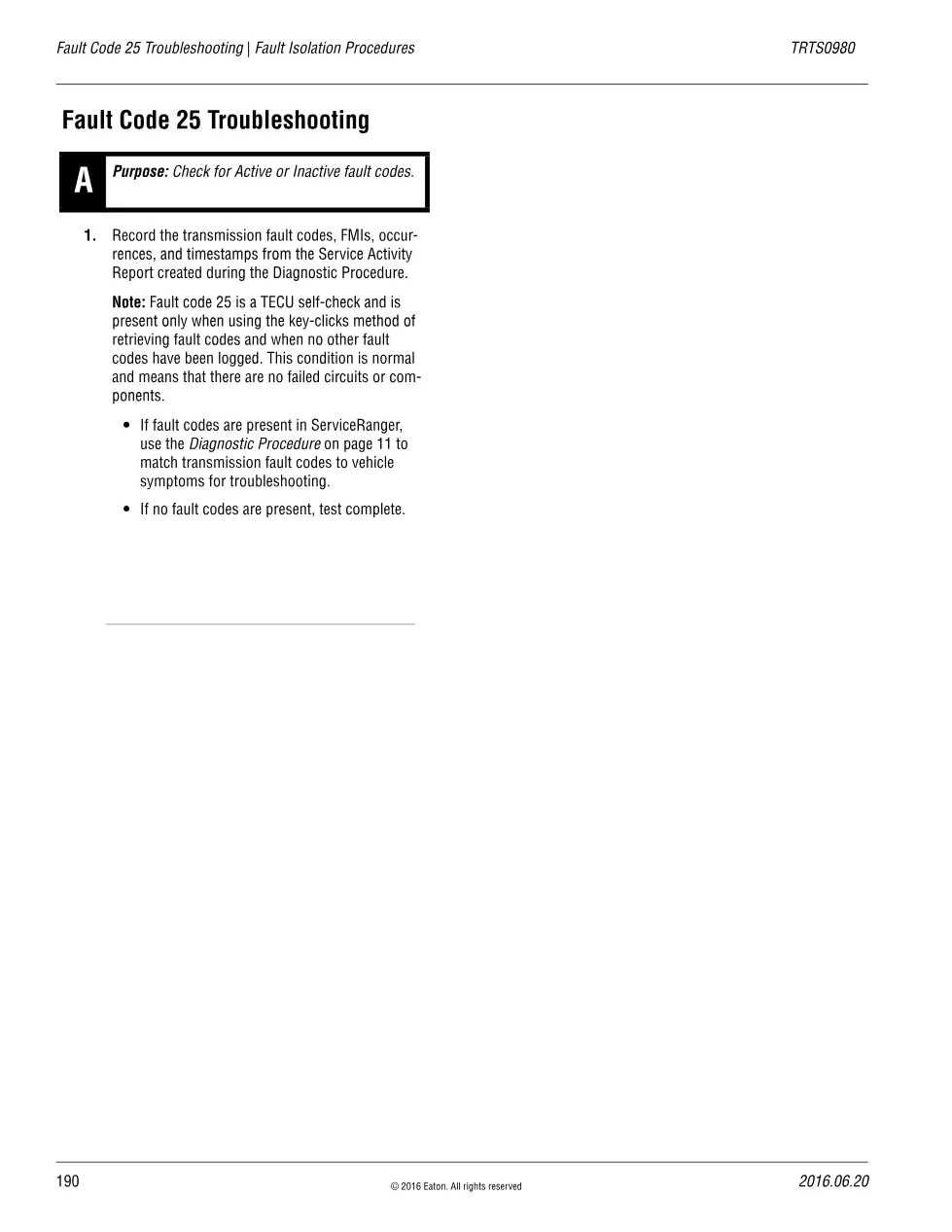
This page documents the Eaton Fault Code 25 troubleshooting step from the TRTS0980 fault isolation procedures for the Fuller Advantage Heavy Duty transmission. Fault Code 25 is a TECU self-check present only when using the key-clicks method to retrieve codes and when no other codes have been logged.
Official document details
| Brand | Eaton |
| Model coverage | Fuller Advantage Heavy Duty automated transmission (DTCs) |
| System / Group | Fuller Advantage Heavy Duty / DTCs |
| Publication no. | TRTS0980 |
| Year / Revision | © 2016 Eaton |
| Pages | 1 |
| File size | 0.0 MB |
| Format | |
| Language | English |
Inside the Eaton Fault Code 25
- Record fault codes, FMIs, occurrences and timestamps
- Note on the TECU self-check (key-clicks method)
- Normal condition — no failed circuits or components
- If codes are present in ServiceRanger, use the Diagnostic Procedure
- Purpose A: check for active or inactive fault codes
The single step reminds the technician to first record every transmission code, FMI, occurrence and timestamp from the Service Activity Report created during the Diagnostic Procedure. Its key note is that this code is a normal TECU self-check that appears only when codes are retrieved by the key-clicks method and when nothing else has been logged, meaning there are no failed circuits or components. If any codes are present in ServiceRanger, the reader is sent to the page-11 Diagnostic Procedure to match transmission codes to vehicle symptoms; if none are present, the test is complete. This short reference prevents unnecessary parts replacement when the only code shown is the self-check itself, which is easy to misread as a genuine fault.
Applicable truck models
The step applies to the Fuller Advantage Heavy Duty and Fuller Advantage transmissions using the Transmission Electronic Control Unit and the Service Activity Report generated during the Diagnostic Procedure. Verify coverage against your VIN and build sheet on the Eaton Roadranger support.
Who needs the Eaton Fault Code 25
Technicians reading codes by the key-clicks method who see this code appear will use this single-page reference to confirm it is a normal self-check rather than a failed circuit, and to know when to switch to ServiceRanger and the page-11 Diagnostic Procedure.
The complete 1-page PDF is available in the DiagTechPro manuals library; a free account is required to download.
Related manuals library
Sản phẩm liên quan cho hãng này
Cùng brand theo taxonomy hiện có trong catalog WooCommerce.